Steinbeck left us a lively record of an ancient US
I had a great treat reading Nana and Poppi's (my grandparent's), 1962 version of this book. Steinbeck takes us along with his dog Charley on a trip through the US during a period characterized by the nation's racial growing pains.
When I was in Salinas this summer with Neemu, we visited Rocinante, his truck and home during this journey, at The National Steinbeck Center (the link is to another blogger's page with some nice shots of the center - one is included below):
A journey is a person in itself; no two are alike. And all plans, safeguards, policing, and coercion are fruitless. We find after years of struggle that we do not take a trip; a trip takes us.
My wayward spirit makes me a natural consumer of a book like this and Steinbeck did not let me down. I love travel literature*, and if you do too, check it out^!
____________
* Other books I have enjoyed that remind me of this one include: A Walk in the Woods (thank you India D.), On the Road, Zen and the Art of Motorcycle Maintenance, Big Sur, Dharma Bums, Fear and Loathing in Las Vegas, The Sun Also Rises, The Grapes of Wrath, and My Antonia.
^ You may have read a recent NY Times article that raised questions about the authenticity of Steinbeck's account. Check that article out if you haven't. It seems appropriate to quote Steinbeck here. On page 125, he appears to believe that impulse for investigation to reconstruct the past is simultaneously impossible to deny and necessarily insufficient to fully form an account of another person. After burning another man's lost court order to pay overdue alimony, he says: "Good Lord, the trails we leave! Suppose someone, finding [my journalling detritus], tried to reconstruct me from my notes."
The philosophical basis for the science of morality
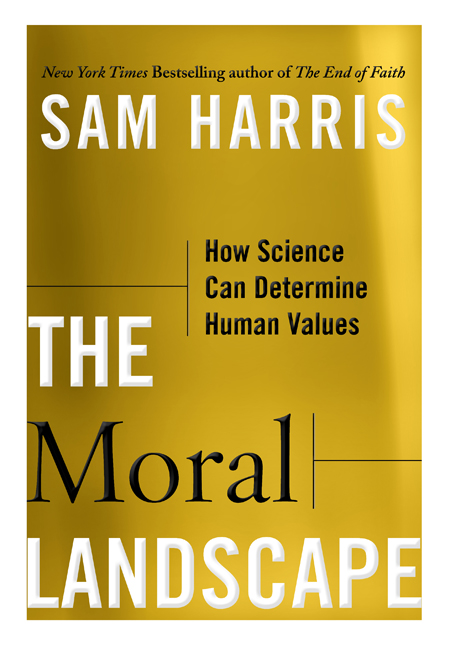
Unlike many of the other books I read, I didn't enjoy this book as much as I expected to. While the book raised a number of interesting philosophical questions (which I had almost without exception encountered elsewhere), Harris did not (and could not in the short book) engage much of the relevant philosophical literature on ethics. Of the scientific and anti-religious material he discussed, the book was at times engaging but, too often, poorly organized.
Ultimately, Harris's motivation to ground discussion of morality in science is one to which I am very sympathetic. It is a motivation that results from his belief that moral questions are ought not be answered by religion*, to which Steven Jay Gould surrendered them with his non-overlapping magisteria. To the extent that I believe that religious evidence is irrelevant to questions in general, I agree with Harris (and Dawkins and others of the new and old atheists who have made this point). The most compelling frameworks we use to organize our experiences are those that are compatible with scientific/naturalistic explanations of the world. This includes moral and cultural values.
That said, we are a very long way from proving which code of conduct will yield the most "well-being" for two people, let alone two cultures (comprising billions of people in the world).^ It is probable that, like many interesting problems (deriving economic forecasts, predicting a chemical reaction from the first principles of quantum mechanics, solving the protein-folding problem in biology, proving or disproving that P = NP in computer science, or demonstrating the truth of a statement in a formal system), it is, in a general sense, intractable. If this is the case, there may be no obvious better system than making corrections to a free-market economy in a liberal democracy via scientific discoveries.**
There may be no chance of (stable) unconditional cooperation among man
Harris correctly points out that without cooperation his dream of higher and higher levels of well-being among nations will not be possible. There have been simulations of repeated interactions among agents that show that while unconditional cooperation is a destination for some game theories, it is often not a final destination.
Martin Nowak does an excellent job of describing the expected long term strategies in repeated games. What he finds in his model is not one final best policy of conduct but instead a repeating cycle of unconditional competition -> tit-for-tat -> generous tit-for-tat -> unconditional cooperation then back to unconditional competition, and on and on.
Check out his lecture to the Royal Society:
I hope to read his book, Supercooperators next.
There are a number of reviews of the Moral Landscape if you are interested in points of view other than mine.
______________
* Typically when scientists rail against religion they are particularly angry with Western religions (the God of Abraham). If by religion we are willing to include Baruch Spinoza's "religion as naturalism" (God = Nature), then the two are completely overlapping (are one magisterium). Most religious people I know would consider Spinoza to be an atheist and as such would be unpalatable. Eastern religions can be even more compatible with naturalistic values, but these are typically not considered.
^ The fact that we do not even have a good definition of "well-being" was discussed in the book, but is perhaps a more important limitation than we fully grasp. Furthermore, even if we had a good definition that was universally accepted (not likely until we have a world without religion - ahem), we will have the problem of intractability. John von Neuman's, minimax theorem works for two people in a zero-sum game, but this is not one of those.
** To claim that there is a better solution would require an argument much more convincing than Harris has proffered. Other objections to any policy are: the problem of unintended consequences (Harris acknowledges), the problem of logistics (any solution relying on cooperation will have cheaters), the problem of evil, the problem of intractability (mentioned in previous footnote); and the problem of learned helplessness (via aid); to name a few. Check out Dead Aid to see possible unintended consequences of even our most humanitarian altruistic impulses:
I have admired Gödel since I read Hofstadter's: Gödel, Escher, Bach: an eternal golden braid. I hadn't read his work as a logician, but would talk with friends about it (and its implications) informally. That is, until I was chatting with Suman in 2008. He could tell that I would benefit from reading a popularization of his incompleteness theorems that dealt more directly with the content of his proof, so he and Anjali gifted me this book for my birthday (Harvey-mas).
The book was a joy to read (man have I been lucky with these books - I seem to say that they all are great). I enjoyed learning about Gödel's life - his life in Vienna, his work on the proofs, and his cherished walks with Einstein, another scientist who Rebecca Goldstein argues is intellectually exiled* by his theories/proofs - and the proof itself.
When I was an undergraduate in an introductory course on philosophy and discussing a number of important proofs, I found myself wishing for an airtight proof that the axioms of an argument were correct. Could there be assurance that I was using the right axioms? If not, I might come to the completely wrong conclusion despite using a rational argument. As you know, in any argument, the conclusions follow from the premises via rules of inference.
At the time, I constructed an argument by analogy that no such proof existed since we could not imagine removing a condition, which we could not imagine removing (e.g. one could not imagine removing from the set of axioms that a human mind is a prerequisite for rational argument). Just as a fish would not have a concept for water (since it had always been fully surrounded by water and there had never been not water for it), so too, we humans could be fully immersed in some set of beliefs or conditions which would be impossible to imagine going without.
Via Gödel's incompleteness theorems**, Gödel proved that such a program was useless: we cannot justify a set of premises in a logical system using the logic alone. If you are interested in the context from which Gödel's work arose, check out: Hilbert's program, and the Liar's paradox (i.e. "This sentence is false".
Implications of incompleteness
While many others extended the incompleteness theorems to the humanities, the computer sciences, and intelligence research (see Penrose for example), Gödel himself was more reticent to extend his theories. He does have this to say about the differences between men and machines though:
Either the human mind surpasses all machines (to be more precise it can decide more number theoretical questions than any machine) or else there exist number theoretical questions undecidable for the human mind.
By this, Gödel seems to suggest that either we are not like a machine (because our decision mechanism is not, at base, mechanical), and we have access to truths that a formal system would find unprovable; or else, we are at base complicated machines that have deluded ourselves into believing we have access to unformalizable mathematical truths.
_______________
* While both Einstein and Gödel achieved a large degree of fame for their discoveries, Goldstein argues that it was the world's subjectivist interpretations of each man's theory that lead to their respective marginalization. For Einstein and Gödel, their work bespoke the objectivist reality of Physics (physical realism) and Mathematics (Platonism).
** From Wikipedia: "For any formal effectively generated theory T including basic arithmetical truths and also certain truths about formal provability, T includes a statement of its own consistency if and only if T is inconsistent."