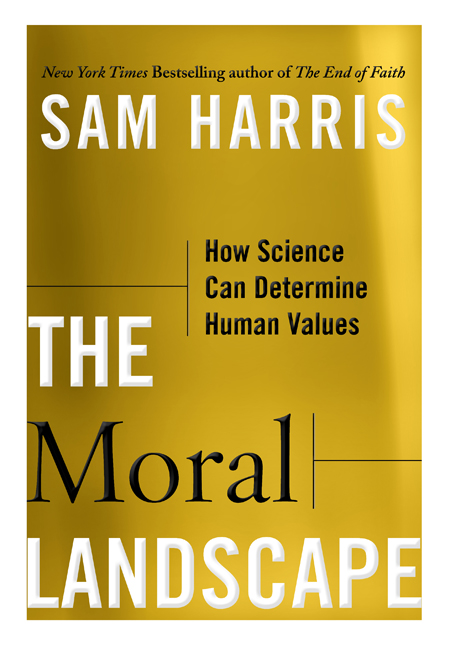
Unlike many of the other books I read, I didn't enjoy this book as much as I expected to. While the book raised a number of interesting philosophical questions (which I had almost without exception encountered elsewhere), Harris did not (and could not in the short book) engage much of the relevant philosophical literature on ethics. Of the scientific and anti-religious material he discussed, the book was at times engaging but, too often, poorly organized.
Ultimately, Harris's motivation to ground discussion of morality in science is one to which I am very sympathetic. It is a motivation that results from his belief that moral questions are ought not be answered by religion*, to which Steven Jay Gould surrendered them with his non-overlapping magisteria. To the extent that I believe that religious evidence is irrelevant to questions in general, I agree with Harris (and Dawkins and others of the new and old atheists who have made this point). The most compelling frameworks we use to organize our experiences are those that are compatible with scientific/naturalistic explanations of the world. This includes moral and cultural values.
That said, we are a very long way from proving which code of conduct will yield the most "well-being" for two people, let alone two cultures (comprising billions of people in the world).^ It is probable that, like many interesting problems (deriving economic forecasts, predicting a chemical reaction from the first principles of quantum mechanics, solving the protein-folding problem in biology, proving or disproving that P = NP in computer science, or demonstrating the truth of a statement in a formal system), it is, in a general sense, intractable. If this is the case, there may be no obvious better system than making corrections to a free-market economy in a liberal democracy via scientific discoveries.**
There may be no chance of (stable) unconditional cooperation among man
Harris correctly points out that without cooperation his dream of higher and higher levels of well-being among nations will not be possible. There have been simulations of repeated interactions among agents that show that while unconditional cooperation is a destination for some game theories, it is often not a final destination.
Martin Nowak does an excellent job of describing the expected long term strategies in repeated games. What he finds in his model is not one final best policy of conduct but instead a repeating cycle of unconditional competition -> tit-for-tat -> generous tit-for-tat -> unconditional cooperation then back to unconditional competition, and on and on.
Martin Nowak does an excellent job of describing the expected long term strategies in repeated games. What he finds in his model is not one final best policy of conduct but instead a repeating cycle of unconditional competition -> tit-for-tat -> generous tit-for-tat -> unconditional cooperation then back to unconditional competition, and on and on.
Check out his lecture to the Royal Society:
I hope to read his book, Supercooperators next.
There are a number of reviews of the Moral Landscape if you are interested in points of view other than mine.
______________
* Typically when scientists rail against religion they are particularly angry with Western religions (the God of Abraham). If by religion we are willing to include Baruch Spinoza's "religion as naturalism" (God = Nature), then the two are completely overlapping (are one magisterium). Most religious people I know would consider Spinoza to be an atheist and as such would be unpalatable. Eastern religions can be even more compatible with naturalistic values, but these are typically not considered.
^ The fact that we do not even have a good definition of "well-being" was discussed in the book, but is perhaps a more important limitation than we fully grasp. Furthermore, even if we had a good definition that was universally accepted (not likely until we have a world without religion - ahem), we will have the problem of intractability. John von Neuman's, minimax theorem works for two people in a zero-sum game, but this is not one of those.
** To claim that there is a better solution would require an argument much more convincing than Harris has proffered. Other objections to any policy are: the problem of unintended consequences (Harris acknowledges), the problem of logistics (any solution relying on cooperation will have cheaters), the problem of evil, the problem of intractability (mentioned in previous footnote); and the problem of learned helplessness (via aid); to name a few. Check out Dead Aid to see possible unintended consequences of even our most humanitarian altruistic impulses:


