Showing posts with label Bernard Baruch. Show all posts

Saturday, November 26, 2011

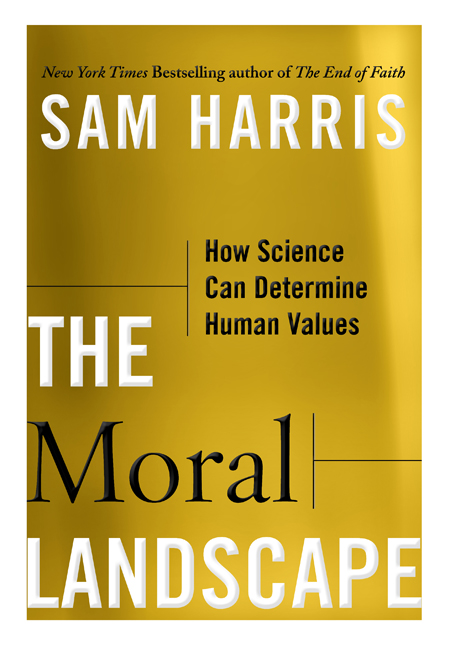
The Moral Landscape (JDC - #10)

The philosophical basis for the science of morality


Unlike many of the other books I read, I didn't enjoy this book as much as I expected to. While the book raised a number of interesting philosophical questions (which I had almost without exception encountered elsewhere), Harris did not (and could not in the short book) engage much of the relevant philosophical literature on ethics. Of the scientific and anti-religious material he discussed, the book was at times engaging but, too often, poorly organized. 

Ultimately, Harris's motivation to ground discussion of morality in science is one to which I am very sympathetic. It is a motivation that results from his belief that moral questions are ought not be answered by religion*, to which Steven Jay Gould surrendered them with his non-overlapping magisteria. To the extent that I believe that religious evidence is irrelevant to questions in general, I agree with Harris (and Dawkins and others of the new and old atheists who have made this point). The most compelling frameworks we use to organize our experiences are those that are compatible with scientific/naturalistic explanations of the world. This includes moral and cultural values.

That said, we are a very long way from proving which code of conduct will yield the most "well-being" for two people, let alone two cultures (comprising billions of people in the world).^ It is probable that, like many interesting problems (deriving economic forecasts, predicting a chemical reaction from the first principles of quantum mechanics, solving the protein-folding problem in biology, proving or disproving that P = NP in computer science, or demonstrating the truth of a statement in a formal system), it is, in a general sense, intractable. If this is the case, there may be no obvious better system than making corrections to a free-market economy in a liberal democracy via scientific discoveries.**

There may be no chance of (stable) unconditional cooperation among man

Harris correctly points out that without cooperation his dream of higher and higher levels of well-being among nations will not be possible. There have been simulations of repeated interactions among agents that show that while unconditional cooperation is a destination for some game theories, it is often not a final destination.

Martin Nowak does an excellent job of describing the expected long term strategies in repeated games. What he finds in his model is not one final best policy of conduct but instead a repeating cycle of unconditional competition -> tit-for-tat -> generous tit-for-tat -> unconditional cooperation then back to unconditional competition, and on and on. 

Check out his lecture to the Royal Society:


I hope to read his book, Supercooperators next.

There are a number of reviews of the Moral Landscape if you are interested in points of view other than mine.
______________
* Typically when scientists rail against religion they are particularly angry with Western religions (the God of Abraham). If by religion we are willing to include Baruch Spinoza's "religion as naturalism" (God = Nature), then the two are completely overlapping (are one magisterium). Most religious people I know would consider Spinoza to be an atheist and as such would be unpalatable. Eastern religions can be even more compatible with naturalistic values, but these are typically not considered.

^ The fact that we do not even have a good definition of "well-being" was discussed in the book, but is perhaps a more important limitation than we fully grasp. Furthermore, even if we had a good definition that was universally accepted (not likely until we have a world without religion - ahem), we will have the problem of intractability. John von Neuman's, minimax theorem works for two people in a zero-sum game, but this is not one of those.

** To claim that there is a better solution would require an argument much more convincing than Harris has proffered. Other objections to any policy are: the problem of unintended consequences (Harris acknowledges), the problem of logistics (any solution relying on cooperation will have cheaters), the problem of evil, the problem of intractability (mentioned in previous footnote); and the problem of learned helplessness (via aid); to name a few. Check out Dead Aid to see possible unintended consequences of even our most humanitarian altruistic impulses:


Saturday, October 15, 2011

Junot Diaz Challenge (100 Books in a year): #4

Advice to Satisfice

In America, if you put your mind to it, you can have anything you want; you just can't have everything you want. -Bernard Baruch  

Book 4 was a treat. Some of the most interesting topics included discussions of questions like: If choice and money are supposed to bring happiness, why hasn't general well-being risen over the last thirty years concomitantly with the significant increases in choice (in our market economy) and GDP?

Schwartz is not the first person to discuss this problem, but his answer is perhaps unique. He arguses that most of our unhappiness comes from too much freedom to choose in areas that are not worth spending time choosing. In particular, when given more choices, we tend to spend more time thinking about our options. This can have unintended negative consequences: we spend longer choosing and not doing the things we really love (opportunity costs); we do mental acrobatics which cost us emotionally as we weigh the options which can lead to feelings of dissatisfaction before and after (anxiety about a bad choice and later, buyers' remorse) our choice; we fall into the trap of believing that materialistic goals can lead to happiness (hedonic treadmill); and by considering more choices, the thing we ultimately choose will necessarily, be a decision not to choose others (we can't have it all) and our choice will suffer by comparison at least in one regard, if not many.

As you might expect, there are others who have thought about how people find happiness, and there has been lots of research on this subject. Nobel Laureate, Herb Simon first coined the portmanteau "satisfice," an amalgam of satisfy and suffice, which describes the strategy of choosing that which is "good enough" as opposed to "the best." Herb Simon suggests that when all the opportunity costs (time spent), real costs (money) and emotional costs (anguish) are considered, satisficing is generally the maximizal strategy. The best solution to (interesting) problems are solutions that are sufficient and satisfactory; they are NOT the objective "best" solution.

Schwartz has identified through his "Maximization scale" (a quiz you can take in the book) who among us are likely to be maximizers and who are satisficers. Furthermore, he finds that satisficers tend to regret their decisions less and enjoy life more, and more worryingly, an abundance of choice can turn a perfectly happy satisficer into a maximizer. If Simon and Schwartz are right, it behooves us to work to become better satisficers and be vigilant against too much choice leading us down the maximization road.

For people like me, who spend so much time thinking about the big decisions: marriage, career, religion, or which stereo to buy, this is welcome advice. I look forward to constraining my decisions in the future to two choices at most (one of the recommendations Schwartz suggests among other good ones in the last chapter of his book). If the options represent satisficing solutions to a given problem, then I can feel comfortable going forward with the one I choose. Philosophically, with the really big problems I have found that I can ameliorate my anxiety about not getting everything in life by appealing to the possibility that all universes exist and my observations are confined to the me living out the (admittedly wonderful, yet contingent) life I have in this universe.

There is an excellent and very watchable animated lecture on motivation that square with the work of Schwartz (and the research he cites) that provides a fuller understanding of why we are not satisfied with material goods. The lecture is given by Dan Pink, another popularizer of scientific research done on motivation, and author of the book Drive, which may be a future blog post. I encourage you to watch this video! In retrospect, this crisis of motivation was a big reason for why I left my job in the financial world.

Finally, if this work interests you and you want to read more, check out Ed Diener's and his son's, Robert Biswas-Diener's, work on subjective well-being (Will Money Increase Subjective Well-Being). The Dieners' are leaders in this field of work and they have many interesting things to say. For example, they have found that the extent to which a person preferences love to money is correlated with subjective well-being.

There are good, subtle arguments in the link above regarding considerations whether the causality flowing in both directions (if am satisfied with my life, might I be more likely to be a good mate choice and thus preference love to money; similarly, if I am not satisfied with my life, might I believe that I can solve my problems by focusing on money?).

Much of this work is interesting and of course we cannot read it all; I hope that my summary has been satisfycing for you.